
How did the reductionist, fast-thinking habits of the mind kill Diversity, Equity and Inclusion (DEI)?
How did the backlash of unwokeness crush the backlash of wokeness? Progressive purism set up populist nihilism.

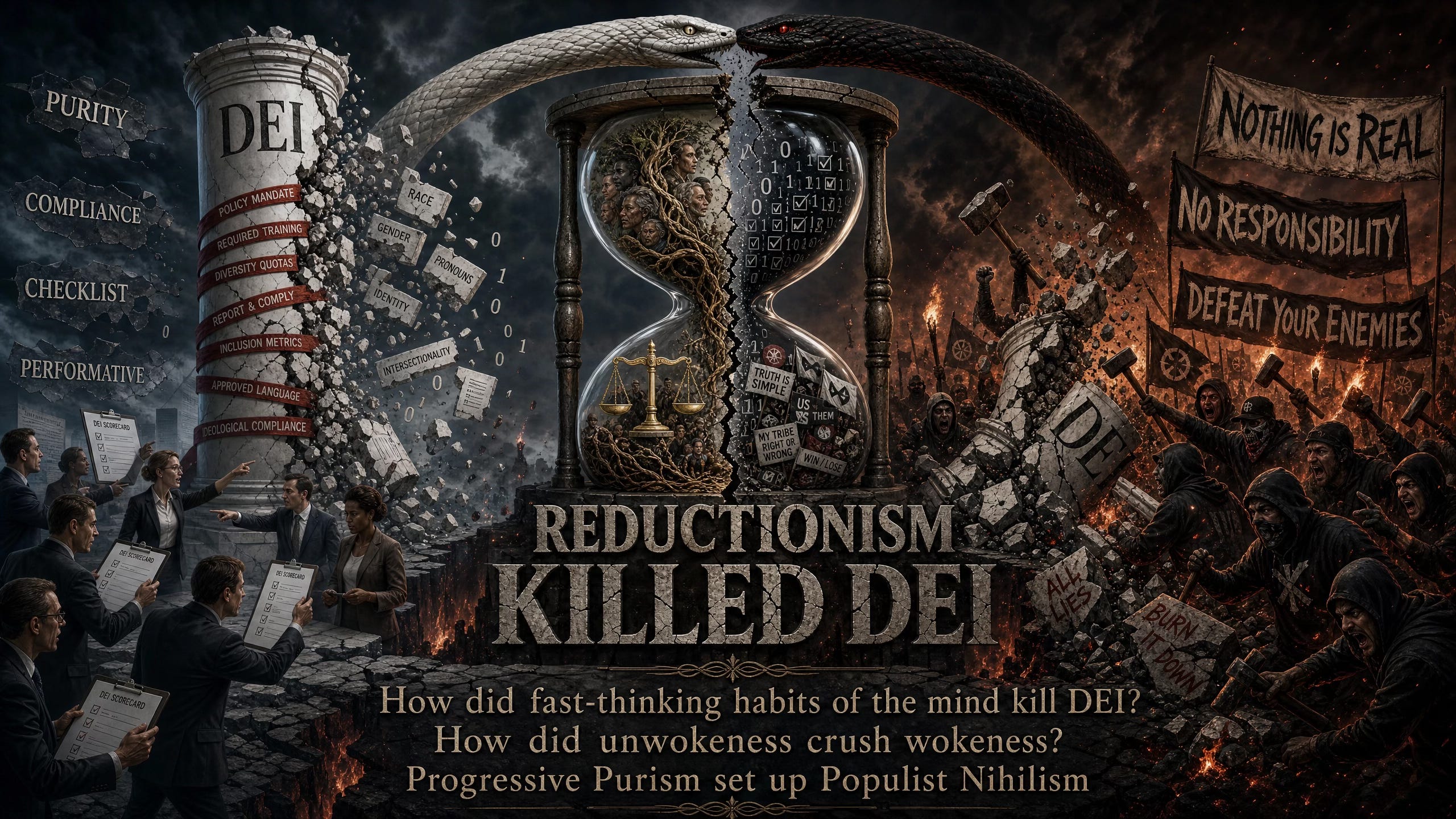
Reductionist, fast-thinking habits of the mind constructed, and then destroyed, Diversity, Equity, and Inclusion (DEI) policies. At its best, DEI was an attempt to honor the dignity, agency, and flourishing of those historically harmed by systems of Bias, Isms, Prejudice, Inequity, and Discrimination (#BIPID).
Yet the dominant paradigm for implementing DEI pursued that profound ethical project with inadequate tools: System 1 (fast, automatic, binary) thinking applied to System 2 (slow, complex, relational) realities. This meant codifying moral aspiration into checklists, performative rituals, and identity arithmetic, flattening thick human experience into thin categories and rigid rules. Ethically, that reductionism hollowed out the purpose of DEI: instead of cultivating justice, repair, and shared responsibility, it increasingly demanded purity, enforced compliance, and rewarded moral sorting.
Within this vacuum, progressive purism produced a moral culture in which the primary virtue became ideological spotlessness rather than relational courage, humility, or solidarity. The ethical purpose drifted from:
“How do we transform systems to become more just?” to
“How do I avoid being wrong, tainted, or called out?”
Morally, this shift re-centered the self and its image rather than the other and their liberation. As a matter of virtue, it rewarded performative indignation over the slow, often unglamorous work of repair, genuine listening, and shared problem-solving. That posture made DEI brittle. Die-hard DEI advocates could not engage with nuance, uncertainty, or good-faith disagreement, even though these dispositions are precisely the conditions under which ethical growth and social learning occur.
On the other side, populist nihilism emerged as a backlash not only against DEI’s excesses and hypocrisies, but against the very idea that knowable structural injustices exist at all. Where progressive purism reduced complexity to rigid categories of purity and guilt, populist unwokeness reduced complexity to derision and suspicion. All claims about BIPID issues became “wokeness,” all data about harm became propaganda, and all attempts at redress became tyranny.
Ethically, this amounted to a wholesale refusal of responsibility. If nothing is trustworthy, then nothing is morally binding, and no one owes anything to anyone beyond their own tribe. Morally, it replaced the question:
“How might I serve my neighborhood and community?” with
“How do I defeat my enemies who are depleting me?”
As a matter of virtue, this shift from service to virtuous victimhood cultivated cynicism, resentment, and cruelty as political habits, recasting empathy and intellectual honesty as weaknesses rather than strengths.
The populist backlash of unwokeness did not simply oppose the progressive backlash of wokeness; it completely destroyed even the diminished form of DEI that progressive purism had left standing. Progressive purism had already narrowed DEI’s ethical horizon to a theater of symbolic correctness. Populist nihilism stepped in to smash even that thin edifice, deploying the same reductionist logic in reverse.
Together, they formed a dialectic of dysfunction: each side’s excesses justified the other’s extremism, and both relied on caricature rather than complexity. The debate over DEI became a competitive, win/lose binary war of identities and slogans rather than a shared, collaborative, win/win inquiry into how to repair historically produced harms in ways that honor everyone’s dignity.
Beneath this conflict lay the hegemony of reductionism over complexity, expressed through dysfunctional political polarization, toxic divisiveness, self-righteous fundamentalism, identity politics, and the futility of the cancel culture wars. Rather than asking difficult, compound philosophical questions (CPQs), such as:
How might we design institutions that acknowledge historical injustices without freezing people into the permanent perpetrator-oppressor-victim dynamics, and the endless battles of the woke versus the unwoke?
These dysfunctional dynamics demanded yes-or-no allegiance to increasingly simplistic camps, with blind unconditional loyalty. Reductionism converted deep moral questions into shallow loyalty tests. This process not only eroded social trust; it also made it nearly impossible for DEI to cultivate the civic virtues of wisdom, prudence, justice, courage, and temperance at scale, because those virtues require careful discernment, contextual sensitivity, and the willingness to revise one’s position in the generative light of better dialogue and mutual understanding.
In this sense, reductionism killed DEI not only as a governance project but as a moral project. These warring reductionist tribes severed the connection between DEI’s stated ethical purpose, justice, inclusion, and repair, and the actual practices used to pursue it: symbolic performativity on one side, scorched-earth denial on the other.
This dysfunctional dialectic stripped moral meaning from the work by replacing lived encounters with scripted performances, honest disagreement with moral panic, and shared responsibility with tribal blame. This schism corrupted the field of virtue itself, rewarding outrage, purity, and contempt over curiosity, humility, and steadfast care.
The implosion of DEI is therefore not simply a story about a culture war. It is a cautionary tale about what happens when we attempt to address complex, morally charged realities with reductionist tools inside indoctrinated political cults that have forgotten how to think critically, and feel empathically, coherently together.
Diversity, Equity, and Inclusion (DEI) as a governing ideal represents both a policy failure and a diagnostic failure of epistemology. The dominant paradigm for implementing DEI has relied on System 1 (fast, automatic, heuristic-based) thinking to address what are unambiguously System 2 (slow, deliberate, complex) challenges. This mismatch between the cognitive and structural demands of BIPID issues (Biases, Isms, Prejudices, Inequities, and Discrimination) and the reductionist tools deployed against them has left DEI perpetually underpowered and politically vulnerable. Into that vacuum has surged an authoritarian-populist counter-reaction that, far from offering a more sophisticated account of complexity, has weaponized the very simplicity it purports to transcend. The result is a cascading collapse of social coherence under the double weight of performative progressive purism and right-wing epistemic nihilism.
For deep divers, leave comments on this google document to improve this work-in-progress as a lifelong intergenerational H.E.N process.
How might we integrate truth-telling and DEI into the creative practices of composing and responding compound philosophical questions (CPQs), woking within beloved learning communities and using Humanist-guided, AI-enabled Emancipatory Neo-learning (H.E.N.) protocols, to develop our complexity thinking-being-doing skills, cultivate equity meta-governance, and manage our entangled web of self-inflicted wicked problems?